Meet Method Ambassador Steven Henderson
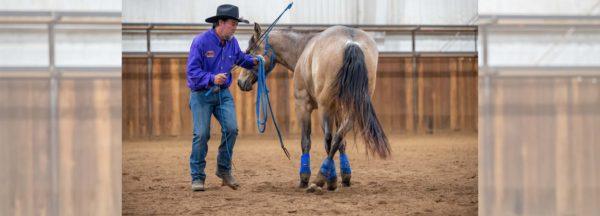
Steven grew up on his family’s farm on the East Coast of Australia. The Hendersons used horses to work their cattle and Steven was in the saddle at a young age. “I’d ride anything I could manage to get on. Some of the horses were decently trained and others were barely broke,” Steven remembers. “It didn’t make a difference to me – I was just happy to be riding.”
It wasn’t until his adult years that Steven found the Method – all thanks to a promise he made to his wife, Nicki. “I ended up with Chance, a gelding that had very limited handling and had developed a few issues. Because I was working long hours, I sent him to a trainer up the road,” Steven says. “When the trainer told us he was ready to go, we went to pick him up and my wife decided to ride him. He lost the plot, and she ended up getting speared to the ground and breaking her shoulder.”
As Steven waited with Nicki in the hospital, she told him that Chance needed to find a new home. “I had no real problems handling him, and knew he wasn’t a bad horse; he just needed to be trained,” Steven says. “I asked her to give me seven days to work with him. If I could get him to a point where she was comfortable with him, we’d keep him and I’d continue to train him.”
Nicki reluctantly agreed to give Steven a week to work with the gelding. “When I walked out of the hospital, all I could think was, ‘How am I going to make this happen in seven days?” Steven remembers.
He knew he needed a better training approach than what he’d been using, so he set to work looking up as much information as he could about horsemanship techniques. His research led him to the Method, and as soon as he began using the exercises to work with Chance, he saw an immediate difference in the gelding. By the time the week had gone by and Nicki came out to see Chance’s progress, he was relaxed and in a good frame of mind. “He turned into a great horse. We still have him today and our 9-year-old daughter rides him,” Steven says.
The experience boosted Steven’s interest in the Method, and over the years, he’s worked with a variety of horses, from gentling wild brumbies to reeducating horses with problem behavior. “The Method has worked on every horse I’ve tried it on. It’s similar to the way my dad taught me to train horses years ago but it’s much more refined. I like that there’s a step-by-step process and you know why an exercise or a particular approach works,” Steven says.
Eventually, he got to a point in his horsemanship journey where he wanted more knowledge and attending the Academy was the next step. As a Method Ambassador, Steven enjoys helping people establish safe, enjoyable partnerships with their horses. “So many people get out of horses because they don’t understand how to work with them and end up getting hurt,” Steven says. “Sharing the Method allows me to help people learn how to enjoy their horses and have fun with them.”
Steven is based in Booral, New South Whales, Australia, where he trains horses for the public and teaches private lessons and clinics that focus on the Fundamentals level of the Method. Learn all about Steven on his website and contact him directly at 61-46-0420656 or [email protected].
