Training Tip: Confronting Unfamiliar Objects With Your Horse, Pt 1
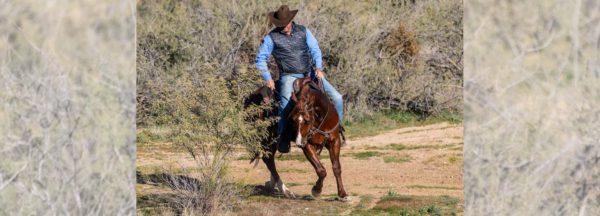
One of the things I love most about riding my horses outside the arena is exposing them to an uncontrolled environment. The arena is what I call a controlled environment. You’ve got four walls around you and everything inside those four walls stays pretty much the same. You can basically control what happens. If the horse spooks or bolts, he can’t run three miles down the road; he’ll eventually be stopped by a fence.
The trail, on the other hand, is an uncontrolled environment. The environment is always changing and you can’t predict all that might happen. A kid could come racing his bike around a bend in the trail, joggers could run up behind you, a deer could jump out of the brush … the possibilities are endless. On the trail, you are at the mercy of the environment, and your horse’s ability to calmly and safely handle whatever situation presents itself relies on his having a solid foundation of training and you being an effective leader.
One of the best ways to train your horse to be a calm, respectful and responsive partner on the trail is to never pass up a training opportunity. When you ride your horse outside the arena, there will be plenty of opportunities to expose him to new objects and reinforce old lessons.
In this short series, I’m going to share four tips to keep in mind when working on building your horse’s confidence with an unfamiliar object.
Tip #1: Go Through the Horse’s Feet to Get to His Mind
The key to building your horse’s confidence around any obstacle is to be a leader and redirect his feet. You want him focused more on you and what you’re asking him to do rather than on the obstacle or spooky object.
When you confront the objects on the trail, use the same approach—circle around or in front of the object and then ask the horse to change directions by turning into the object. Once turned in the new direction, immediately get them trotting or loping a circle.
You repeat this until the horse is tuned in to you and responding well to your cues. The key is hustling the horse’s feet and doing lots of changes of direction. Once the horse is focused on you, he won’t be worried about the obstacle. He will be using the thinking side of his brain—and that’s something you can work with.
Looking for more training tips? Check out the No Worries Club. Have a training question? Send it to us at [email protected]
